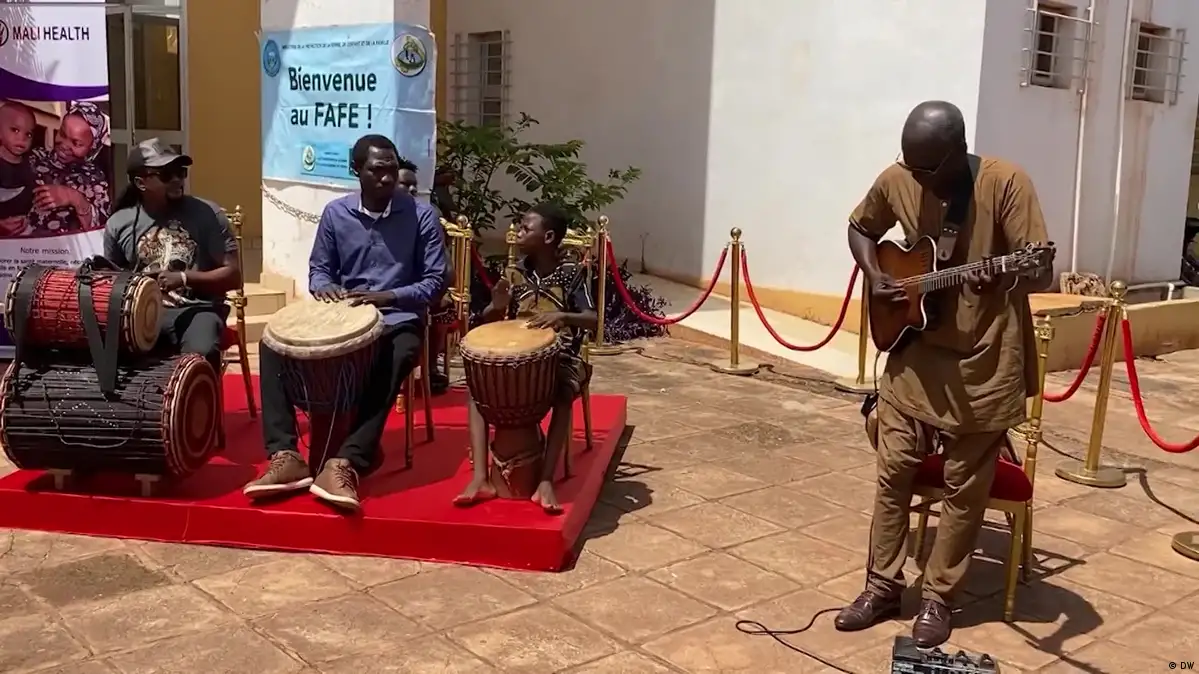
(From DW, 12/13/2025.)
In Mali, music was once silenced by extremists, but some refused to stop. Now they are rebuilding, keeping traditional sounds alive, and helping the next generation rise through rhythm.

 (Jason Jay Smart’s article appeared in the Kyiv Post, 7/7.)
Incredibly, due to years of Russian occupation, many Ukrainian soldiers do not recognize some of the “classic” Ukrainian songs that Benny Stewart sings for them when visiting the front. However, Stewart keeps performing with the certainty that more Ukrainian folk culture is a healthy respite and from the war they fighting and uplifting. What adds a degree of uniqueness to Stewart’s passionate support for Ukraine’s language, folk culture, and music is that he himself is an outlier: Stewart is not Ukrainian. He is an American without any Ukrainian roots.
Nonetheless, Stewart is a convinced and tireless evangelist of Ukraine’s traditions.
In the eyes of Stewart and much of the outside world, Ukrainians are fighting and dying to preserve the territory and border they acquired legally i in 1991. But for those on the ground, the war is not only about territory and sovereignty. It’s also a war really a war in defense of national identity – culture, language and history, things that Russian imperialists in whatever political shape have been trying to destroy for centuries.
Benya has visited the frontline five times with the Ukrainian organization UA Firstaid to deliver medical supplies and to perform and spend time with beleaguered troops. He co-founded the “From Ohio With Love” campaign which raised over $100,000 for humanitarian aid in the first year of the invasion. He has taught folk singing and performed all over Ukraine, most recently organizing a “de-occupation tour” of cities and towns in the Kharkiv region which endured Russian occupation.
(Visit)

(Alex Ross’s article appeared in the New Yorker, 5/13; Zemlinsky, once regarded as a weak-willed eclecticist, is attracting modern admirers. Illustration by Romy Blümel.)
The Musica Non Grata series, in Prague, explores the glittering, elusive world of Alexander Zemlinsky.
Alexander Zemlinsky, who composed several of the most subtly entrancing operas of the early twentieth century, embodied the cosmopolitan chaos of the old Austrian Empire. His father came from a Slovakian Catholic family; his mother was a Sarajevo native of Sephardic Jewish and Muslim descent. Born in Vienna in 1871, Zemlinsky apprenticed there under Gustav Mahler; had an illustrious stint conducting at the New German Theatre, in Prague; and later landed at the radical-minded Kroll Opera, in Berlin. His mature works draw, variously, on Charles Baudelaire, Oscar Wilde, Rabindranath Tagore, and Langston Hughes. To what nation or tradition does such a polymorphous figure belong? A sorcerer of orchestration, Zemlinsky wrote music that glimmers ambiguously in the air, and his life seemed to do the same.
In April, I went to Prague for the final installment of a four-year series called Musica Non Grata, which focussed on German-speaking Jewish composers who thrived in the First Czechoslovak Republic, between 1918 and 1938. The principal venue was the Prague State Opera, as the New German Theatre is now known. The German government provided support, memorializing the Germanophone culture that once flourished in Czech lands. Two of Zemlinsky’s operas, “A Florentine Tragedy” and “Kleider Machen Leute” (“Clothes Make the Man”), were presented on the final Musica Non Grata weekend. As it happens, I had recently seen Zemlinsky’s “Der Zwerg” (“The Dwarf”) at L.A. Opera, whose music director, James Conlon, is a tireless advocate of composers who lost their careers—and sometimes their lives—to the Nazis.
Efforts to recuperate artists who were victims of prejudice might be seen as special pleading. Would the music of the historically oppressed—whether the composers are Jewish, Black, or female—compel our attention if we knew nothing of their struggles? Aren’t we rewriting history to compensate for past misdeeds? Such questions suffer from the dubious assumption that the core repertory has emerged from a purely organic process unaffected by sentimental factors. Consider how the cult of Mozart dwells on his early death, or how that of Beethoven emphasizes his deafness. In any case, no revival of a forgotten composer can be rooted in anything but love, and Zemlinsky’s circle of devotees, while not exactly vast, is steadily expanding.
His musical gifts were never in doubt. Recordings of his work as a conductor are meagre, but his contemporaries praised him as an expert, elegant interpreter of modern and classic repertory alike. Igor Stravinsky, not one to hand out compliments freely, recalled a Zemlinsky-led performance of “The Marriage of Figaro” as the “most satisfying operatic experience of my life.” In Prague, Zemlinsky selflessly promoted not only his fellow-Viennese, like his brother-in-law Arnold Schoenberg and members of the Schoenberg school, but also Stravinsky, Bartók, Hindemith, and Weill. Having begun as an acolyte of Brahms, Zemlinsky brushed against atonality, neoclassicism, and popular song. His openness to myriad influences caused him to be perceived as a weak-willed eclecticist. But Theodor W. Adorno, in a beautiful defense of Zemlinsky’s music, questioned the belief that “force is an integral part of greatness,” arguing that there is genius in sensitivity, empathy, and reticence.
“Der Zwerg” (1919-21), an adaptation of Wilde’s story “The Birthday of the Infanta,” has long been the most often performed of Zemlinsky’s eight operas. I had previously seen productions at the Spoleto Festival, in 1993, and at the Komische Oper, in Berlin, in 2002. The story, in which a dwarf falls in love with a cruelly teasing princess, has autobiographical dimensions: throughout his life, Zemlinsky felt like a freakish outsider. In 1900, he became smitten with the composer Alma Schindler, who found him at once “horribly ugly” and “touchingly sweet.” (She dropped him in favor of Mahler, who was neither.) The omnipresence of antisemitism in Vienna must have shadowed the opera’s conception.

Melvyn Bragg and guests discuss the dance which, from when it reached Britain in the early nineteenth century, revolutionised the relationship between music, literature and people here for the next hundred years. While it may seem formal now, it was the informality and daring that drove its popularity, with couples holding each other as they spun round a room to new lighter music popularised by Johann Strauss, father and son, such as The Blue Danube. Soon the Waltz expanded the creative world in poetry, ballet, novellas and music, from the Ballets Russes of Diaghilev to Moon River and Are You Lonesome Tonight.
With
Susan Jones
Emeritus Professor of English Literature at the University of Oxford
Derek B. Scott
Professor Emeritus of Music at the University of Leeds
And
Theresa Buckland
Emeritus Professor of Dance History and Ethnography at the University of Roehampton
Producer: Simon Tillotson

| (via Jane Dubin)
Hi all, I was so moved by your responses to Rooted One to All, the first single released from Village of Vale, the new musical I am producing. Another song from the show is now available – A New Family
Get a peek behind the scenes (1 min) Find us on IG: @VillageofVale Enjoy Best Jane Dubin New Songs: Rooted One to All and A New Family |
(via Jane Dubin)
|
Hi friends, I have shared many projects over the years. But I have a special place in my heart for my current work, the original musical, The Village of Vale. We are currently developing the show as an audio drama, and released our first single, Rooted One to All, on Friday, 1/12. This has been a labor of love for me and for our whole team and this entry into the world means everything. You can hear the song here. Please listen and listen again. And then share! And follow us on IG and FB @VillageofVale for news of our next releases.
We’ve prepared an inside look of the making of the song and of our team at work. I hope you’ll watch and then listen on Spotify and everywhere music is shared. Let me know if you’re interested in hearing more. And let me know what you’re up to. |
| All best, Jane Dubin Producer Double Play Connections |

(Edward Kiszus’s article appeared on Opening Night Online, 12/19/2023; Photo: Handel’s Messiah performed by the Oratorio Society of New York at Carnegie Hall.. Photo by Edward Kliszus.)
Handel’s Messiah performed by the Oratorio Society of New York at Carnegie Hall.
Accompanied by a coterie of gifted solo artists, a bespoke Kent Tritle strode to center stage in a radiant, scarlet jacket to conduct Handel’s Messiah (1741) by the Oratorio Society of New York. The full house erupted into a resounding applause befitting the greatest historical luminaries of choral conducting, like Robert Shaw, Sir David Willcocks, and Sir George Solti.
The sublime opening intones of the opening Sinfonia, set in a stately French overture form, established the work’s overall pathos and foundation for the first Arioso performed by tenor Martin Bakari. With ‘Comfort Ye’ and ‘Ev’ry Valley,’ Bakari demonstrated his crisp diction, articulation, expressive power, and mastery of swift melismatic passages.
Tritle conducted with bravura, inspiration, and precision. His choices of dynamics and tempi built energy, excitement, urgency, and intensity. Messiah emerged as a living, breathing entity of vitality and passion. For audiences new and seasoned, Tritle reinvented and refreshed Messiah, crafting its musical treasures for heightened accessibility as he delivered glorious crescendi and decrescendi.
These variations of dynamics occurred within the scope of Tritle’s faithfulness to the precepts of Baroque Affektenlehre that masterfully characterized anticipation of the Messiah’s arrival, the sorrow of his crucifixion, and the glory of his resurrection. After all, Handel’s score markings are less about dynamics and more associated with tempo and atmosphere with terms like Largo, Larghetto, Allegro, and Andante. Tritle displayed his unwavering commitment to excellence and ability to connect with an audience through music’s expressive power.
Countertenor Daniel Moody demonstrated his dramatic vocal authority throughout the concert. Moody’s extended range projected ethereal beauty, while his vocal agility displayed a fluid and effortless musical flow. Moody’s vocal acrobatics and virtuosity conveyed a sense of passion and conviction essential to the interpretation of Messiah. We heard this and more in Moody’s performance of ‘O thou tellest good tidings to Zion.’
John Brancy, bass-baritone, projected a deep and powerful aural narrative. His strong presence conveyed a sense of solemnity and gravity as in the aria “Why do the nations so furiously rage together?” Brancy also expressed triumph and joy, as noted in “The trumpet shall sound” with the addition of virtuoso trumpeter Maximilian Morel. Brancy’s role served as a key element in the work’s rich and dynamic sound tapestry.
(from Democracy Now!, Dec 25, 2023 Latest Shows .)
Support our work: https://democracynow.org/give His name might not be familiar to many, but his songs are sung by millions around the world. Today, we take a journey through the life and work of Yip Harburg, the Broadway lyricist who wrote such hits as “Brother, Can You Spare a Dime?” and who put the music into The Wizard of Oz. Born into poverty on the Lower East Side of Manhattan, Harburg always included a strong social and political component to his work, fighting racism and poverty. A lifelong socialist, Harburg was blacklisted and hounded throughout much of his life. We speak with Harburg’s son, Ernie Harburg, about the music and politics of his father. Then we take an in-depth look at The Wizard of Oz, and hear a medley of Harburg’s Broadway songs and the politics of the times in which they were created. This is a rebroadcast of a 2018 program. Democracy Now! is an independent global news hour that airs on over 1,500 TV and radio stations Monday through Friday. Watch our livestream at democracynow.org Mondays to Fridays 8-9 a.m. ET. Subscribe to our Daily Email Digest: https://democracynow.org/subscribe

(Tim Ashley’s article appeared in the Guardian, 8/19; Dramatic pressure … Endgame. Photograph: Sisi Burn.)
Royal Albert Hall, London
For its UK premiere, György Kurtág’s opera faced a challenge summoning the play’s claustrophobia in this venue, but performances and players were superb
Michael Billington, writing about Endgame in these pages a while ago, once used the phrase “the terrible music of Beckett’s prose” to describe the bitter beauty of the play’s language. In György Kurtág’s opera, the words retain their fierce, lacerating power, though the music extends a deep and ambivalent compassion to Beckett’s characters even as their rebarbative sparring masks fears of decline, isolation, endings and loss. This is not, in essence, the bleak comedy we often find, but a work of pervasive sadness that continues to haunt us after its final notes have died away.
Considered a masterpiece by many at its 2018 Milan premiere, Endgame (more correctly Fin de Partie, as Kurtág uses the French text) has now been given its first UK performance at the Proms by the BBC Scottish Symphony Orchestra under Ryan Wigglesworth, in a semi-staging by Victoria Newlyn. Playing and conducting, as one might expect, were superb. Wigglesworth dug deep into the score’s detail while maintaining the dramatic pressure throughout, and you couldn’t help but be struck both by Kurtág’s fastidious craftsmanship and the way every verbal and musical gesture tells, often through the sparest and simplest of means. Flaring brass suggested fury, futile or otherwise, and cimbalom taps quietly frayed the protagonists’ nerves. But there were also moments of quite extraordinary beauty, particularly as Nell (Hilary Summers) and Nagg (Leonardo Cortellazzi) lose themselves in memories of the past.
Available on BBC Sounds until 9 October. The Proms continue until 9 September.

Prom 36 – A Space Odyssey-The London Philharmonic Orchestra conducted by Edward Gardner (Jennifer France: soprano, Clare Presland: mezzo-soprano,
Edvard Grieg: Kor, Royal Northern College of Music Chamber Choir, London Philharmonic Choir) perform György Ligeti: Requiem and Lux aeterna followed by Richard Strauss: Also sprach Zarathustra at the Royal Albert Hall on Friday 11 August 2023
Photo by Mark Allan
PROM 36 A SPACE ODYSSEY: LPO/GARDNER REVIEW
(Tim Ashley’s article appeared in the Guardian, 8/13. )
Royal Albert Hall, London
Intense and finely focused performances of the Ligeti and Strauss pieces used in Kubrick’s sci-fi epic revealed every detail of their unearthly majesty and awesome extremes
Like many, I first heard György Ligeti’s music on the soundtrack of Stanley Kubrick’s 2001: A Space Odyssey when I was a teenager, and for some years after was unable to dissociate its unearthliness from Kubrick’s ambitious vision of human evolution as a product of alien intervention. Edward Gardner’s London Philharmonic Prom marked this year’s Ligeti centenary by acknowledging 2001’s grip on our imaginations, placing his Requiem and Lux Aeterna alongside Strauss’s Also Sprach Zarathustra. It’s hard to dissociate the Strauss from some of the film’s most iconic moments, either.
Bleak and sparse despite the awesome volume of sound it can generate, the Requiem, completed in 1965, offers no comfort for the fear and violence it evokes, and hearing it complete (Kubrick only uses the Kyrie) can be unsettling. Gardner’s interpretation was a thing of extremes. The quiet, penumbral opening Introit seemed to hover on the verges of sound and silence. Later, the roaring brass of the Dies Irae pinned you to your seat. The combined forces of the London Philharmonic Choir, Royal Northern College of Music Chamber Choir, and Norway’s Edvard Grieg Kor (Gardner is also their chief conductor) sang with furious intensity. Jennifer France and Clare Presland were the hieratic soloists, their voices finely blended in the ambivalent closing Lacrimosa, its oscillating vocal lines fading away in irresolution.
Live at the BBC Proms: Edward Gardner conducts the London Philharmonic Choir & Orchestra, RNCM Chamber Choir and Edvard Grieg Kor, in music by György Ligeti and Richard Strauss.
Presented by Georgia Mann, live from the Royal Albert Hall.
György Ligeti: Requiem
c. 8.05 pm
Interval: Matthew Sweet, presenter of Radio 3’s programme Sound of Cinema, joins Georgia Mann to discuss the use of music in film by Stanley Kubrick.
c. 8.25 pm
György Ligeti: Lux aeterna
Richard Strauss: Also sprach Zarathustra
Jennifer France (soprano)
Clare Presland (mezzo-soprano)
Edvard Grieg Kor
Royal Northern College of Music Chamber Choir
London Philharmonic Choir & Orchestra
Edward Gardner (conductor)
György Ligeti was one of the boldest voices of the 20th century – a composer whose radical vision brought wit as well as invention to the world of contemporary classical music. Tonight, we hear two of his most famous works – the dramatic Requiem paired with the shimmering Lux aeterna, both of which featured in Stanley Kubrick’s sci-fi epic 2001: A Space Odyssey. Also featured in the film was Richard Strauss’s Also sprach Zarathustra, with the iconic brass opening that calls to mind the image of the sun rising over the Earth and Moon.